
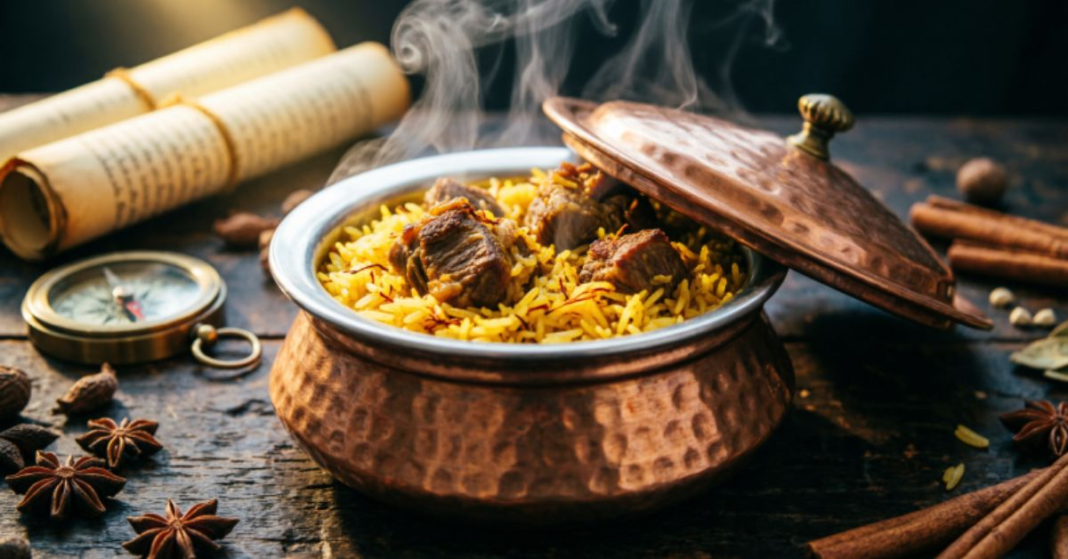

Biryani is not a rice dish; it is complex culinary engineering, a pressure managed, thermodynamically precise, aromatic layering system assembled over 1,800 years of human migration, trade conflict, and imperial ambition. Most histories begin in the wrong century. This is the corrective record.
Quick Answer: Is Biryani Mughal or Indian?
Biryani is a convergence not exclusively Mughal, not exclusively Indian. Tamil Sangam literature (c. 300 BCE to 300 CE) references layered rice meat preparations 1,700 years before the Mughal Empire. Persian technique, Central Asian trade routes, and indigenous subcontinental cooking collectively built the system we now call Biryani.
Jump To Section
- Origins: Oon Soru vs. Mughal Biryani Comparison Table
- The Pre-Chili Era Before 1498
- The Science of Dum Thermodynamics Explained
- The Potato Myth Poverty or Flavour Engineering?
- Biryani vs. Pulao Technical Verdict
- Regional Variants
- FAQ
Origins: Oon Soru vs. Mughal Biryani
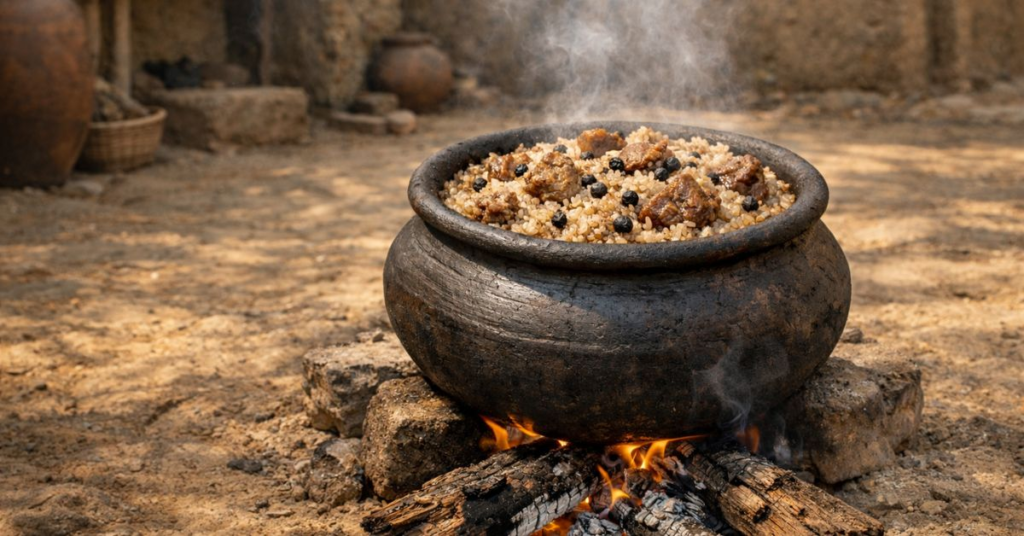
Oon Soru predates the Mughal Empire by 1,700 years. This table compares both culinary systems across six dimensions settling the origin debate with evidence, not opinion.
| Dimension | Oon Soru (c. 300 BCE to 300 CE) | Mughal Biryani (c. 1526 CE onward) |
| Source | Tamil Sangam texts (Purananuru, Akananuru) | Mughal court records, Ain-i-Akbari |
| Cooking Logic | Rice + meat in fat; cooked in coordination | Layered rice + meat; sealed dum steam-pressure finish |
| Primary Heat | Black pepper (piperine), dried ginger (sonth) | Black pepper + post-1498 red chili (capsaicin) |
| Aromatic Register | Turmeric, pepper, ghee | Saffron, rosewater, birista, whole spices |
| Vessel | Open or semi-closed clay pot | Sealed handi with atta lagan (dough rope) |
| What Changed | Foundation: rice-protein coordination in fat | Refinement: formalized dum protocol + Persian aromatic layer |
The verdict: The Mughals did not invent Biryani. They produced its most sophisticated expression. Oon Soru is the root; Mughal Biryani is the branch the world recognizes today.
The Pre-Chili Era What Biryani Tasted Like Before 1498
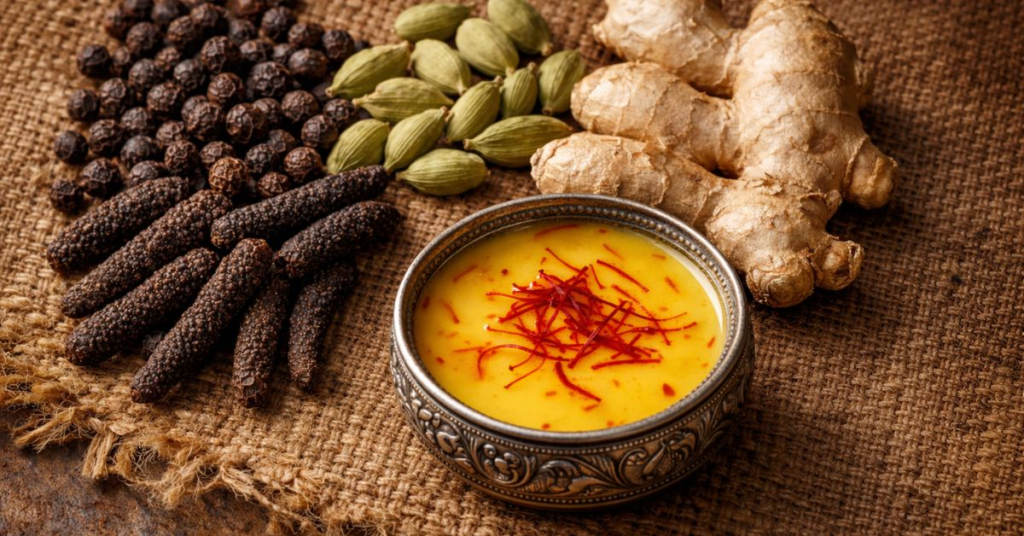
Before 1498, Biryani contained zero red chili. Heat came from black pepper, long pepper, dried ginger, and cubeb pepper, a darker, more resinous profile where saffron and rosewater were clearly perceptible, unmasked by capsaicin.
When Vasco da Gama anchored off the Malabar Coast in 1498, he triggered a spice-trade realignment that introduced Capsicum annuum via Portuguese Goa. The pre 1498 heat matrix:
- Black pepper (Piper nigrum): Primary heat source. Piperine delivers slow, diffuse warmth, not capsaicin‘s frontal punch. Also enhanced curcumin absorption, making pre-chili Biryani more bioactive.
- Long pepper (Piper longum): More pungent and resinous, with a slightly sweet undertone.
- Dried ginger (sonth): Sharper and more camphorous than fresh ginger.
- Cubeb pepper: Nearly extinct from South Asian cooking today; eucalyptus-like, medicinal heat.
The pre 1498 flavor profile sat closer to a Persian polo than to any modern Hyderabadi version.
Key insight: Every “authentic” Biryani you have eaten is a post-colonial construction, shaped by a Portuguese maritime trade route.
The Science of Dum Thermodynamics Inside a Sealed Vessel
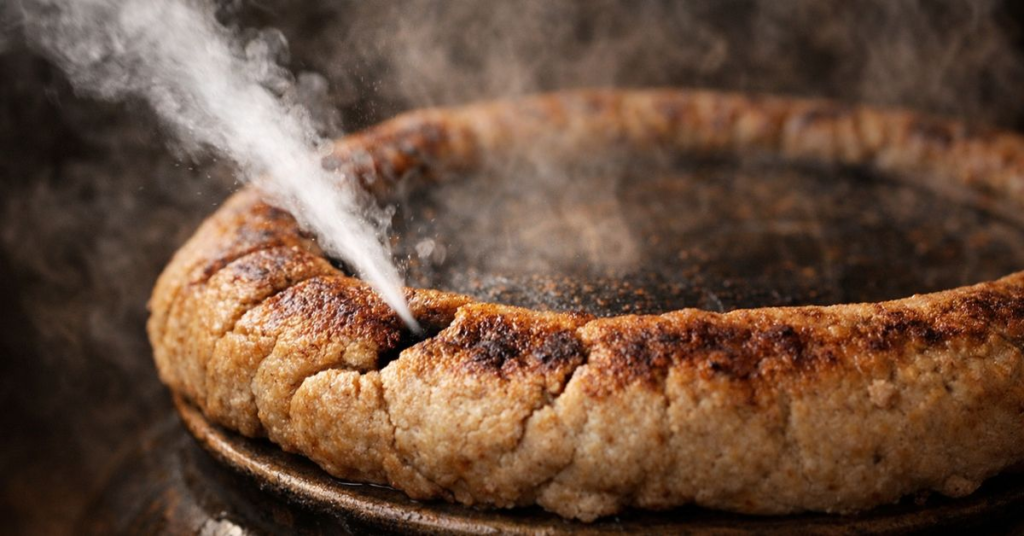
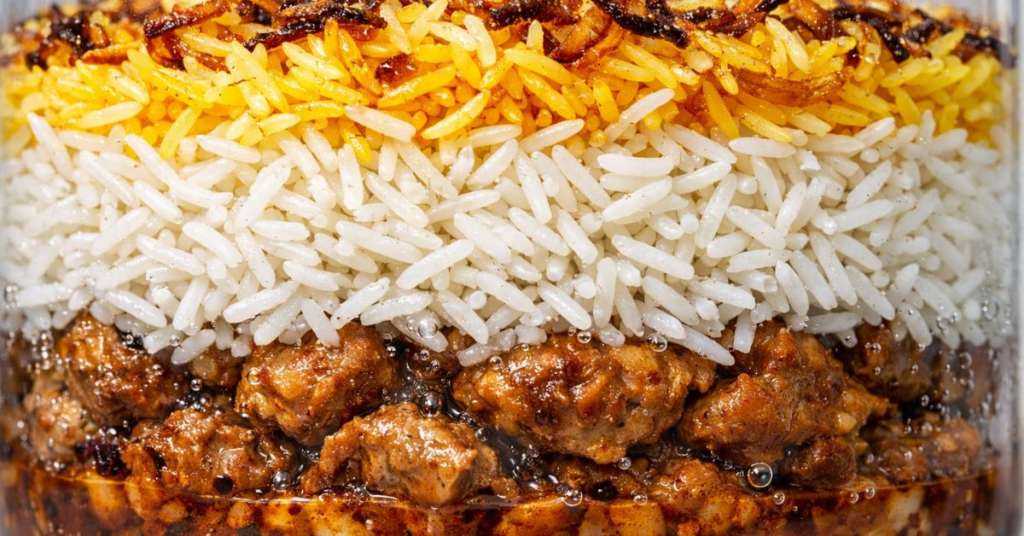
Dum is not slow cooking, it is precision steam-pressure engineering. A sealed handi locks internal temperature at 100 to 110°C, triggering starch gelatinization control, collagen breakdown, and aromatic infusion simultaneously. This is why Biryani cannot be replicated in an open pot.
When a handi is sealed with atta lagan, trapped steam builds pressure; temperature stabilizes at 100 to 110°C. Three processes fire at once:
- Starch gelatinization control: Granules gelatinize at 60 to 80°C. At the dum stage, rice is ~70% cooked. Steam completes the final 30% without liquid submersion preserving Basmati grain integrity.
- Collagen breakdown: Meat collagen converts to gelatin at 70 to 80°C. Near 100% humidity prevents desiccation yielding meat that is tender and moist simultaneously.
- Aromatic infusion: Volatile compounds from birista, saffron, and whole spices suspended in steam. A pressure gradient drives them into each grain the mechanism behind rice that “smells from the inside.”
Why your rice breaks: Par-boiling beyond 70% leaves no structural reserve for dum. The chalky white center in a properly par-boiled grain is structural insurance not undercooking.
The Potato Myth Poverty Story or Flavour Engineering?
The Kolkata Biryani potato is not a poverty era meat substitute. It is a passive flavor concentrator absorbing aromatic ghee, meat gelatin, and spice infused steam simultaneously inside the sealed dum environment. This effect cannot be replicated outside a sealed vessel.
Standard narrative: Nawab Wajid Ali Shah, exiled to Calcutta by the British in 1856, inserted potato as a cheap meat extender. Historically convenient and worth interrogating.
A whole potato inside the dum environment absorbs ghee, meat drippings, and spice-infused steam at once carrying a concentrated burst of every aromatic layer: saffron, rosewater, caramelized onion, meat gelatin. Adding a separately boiled potato to finished Biryani produces none of this. The dum environment is the mechanism, not the poverty.
Military footnote: The Soldier’s Ration framework linked to Mughal field logistics under Mumtaz Mahal’s direction explains Biryani’s single-pot efficiency: carbohydrates, protein, fat, and antimicrobial spices in one sealed vessel, with dum cutting fuel consumption. The architecture is field-kitchen optimized by design.
Biryani vs. Pulao The Technical Verdict
Biryani and pulao are not variations of the same dish they are different engineering systems. “Veg Biryani” cooked via absorption is, by structural definition, a pulao.
| Criterion | Biryani | Pulao |
| Cooking Method | Par-boil + layer + dum | Single-phase absorption |
| Starch Control | Active steam finish preserves grain | Passive stock to rice ratio |
| Protein Placement | Layered separately; distinct zones | Uniform throughout |
| Aromatic Depth | Multi-layer: crust / meat / top note | Single uniform layer |
| Grain Goal | Individual, structurally intact | Cohesive, sometimes sticky |
A genuine vegetarian Biryani is achievable with paneer, mushroom, or jackfruit but only when the full dum system is engaged.
Regional Variants Ecology, Ingredients & Deep Dives
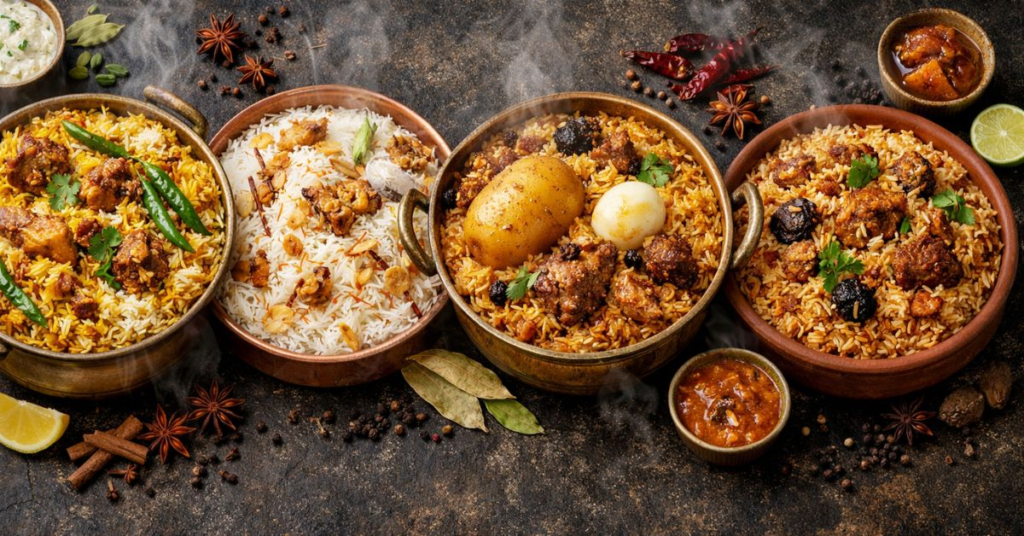
Each regional Biryani is an evolutionary adaptation to local ecology, trade access, and cultural contact, not a competing claim to authenticity. The ingredient differences are not arbitrary; they are direct responses to geography, climate, and historical trade corridors.
Hyderabadi Biryani
Why it tastes the way it does: The Deccan Plateau sits at a geographical crossroads Mughal administrative influence from the north collided with Telugu and Marathi spice traditions from the south. The result is the kachchi method: raw marinated meat and par-boiled rice sealed together in the handi simultaneously. This is the highest technical difficulty in the Biryani system because both protein and starch must reach doneness at the same moment inside one sealed vessel.
The marinade heavy on yogurt, raw papaya (papain enzyme for collagen breakdown), and green chili compensates for the absence of pre cooking. Hyderabad’s inland position, away from coastal humidity, also means its saffron milk ratio runs richer, since drier air allows aromatic compounds to concentrate without moisture interference.
Memoni Biryani
Why it tastes the way it does: The Memon community’s ancestral territory straddles the Sindh-Gujarat border, a semi-arid zone historically dominated by pastoral livestock trading rather than agricultural abundance
. This ecological context explains the Memoni spice architecture: no food coloring (historically unavailable), no rosewater or saffron (luxury imports too expensive for a trade community constantly on the move), and a sharper, more aggressive red chili hand inherited from the Gujarat coastline’s proximity to Portuguese Goa. The heavy yogurt marinade is also ecological in arid, pre-refrigeration conditions, acidic marinades were the primary meat preservation mechanism. What looks like minimalism is actually adaptive efficiency.
Sindhi Biryani
Why it tastes the way it does: The souring agent in Sindhi Biryani dried plums (aloo bukhara) is the most ecologically legible ingredient in any regional variant. The Indus Valley corridor, through which Sindhi trade historically flowed, connected Central Asian dried-fruit markets directly to the subcontinent. Aloo bukhara (from Bukhara, in present-day Uzbekistan) arrived via these routes and entered the kitchen as both a flavor agent and a functional one
: its tartaric and malic acids lower meat pH, accelerating collagen breakdown during dum without requiring extended cooking time. Tomatoes serve a secondary souring role. The ecological logic is clear: a community positioned on a trade route used what the trade route brought.
Lucknawi (Awadhi) Biryani
Why it tastes the way it does: Lucknow’s Nawabi court (c. 18th century) operated at the height of Mughal cultural refinement and that restraint is encoded in the Biryani. The pakki method (meat pre-cooked separately before layering) eliminates the technical risk of the kachchi approach, allowing cooks to focus entirely on aromatic precision.
Saffron is infused in warm milk rather than water because milk’s fat content dissolves saffron’s fat-soluble pigment crocin more completely producing a deeper color and fuller aromatic release. The Gangetic Plain’s access to premium dairy made this an ecologically natural choice. Lucknawi Biryani is the product of a dish that had time, resources, and refinement and it tastes exactly like that.
Ambur / Tamil Nadu Biryani
Why it tastes the way it does: Ambur Biryani uses seeraga samba, a short-grain, intensely aromatic variety cultivated in Tamil Nadu’s river delta plains rather than imported Basmati. This is the most direct ecological choice in the entire Biryani family: use what grows locally and what has grown locally for 2,000 years.
The tomato-forward base reflects the region’s proximity to Andhra Pradesh’s chili and tomato agriculture. More significantly, Ambur’s spice profile carries the lowest saffron dependency of any major variant because historically, saffron was a Mughal-era import luxury that Tamil cooking never required. Ambur Biryani is the Oon Soru lineage made visible: the oldest living branch, least modified by Mughal influence, closest to the 300 BCE origin point.
The Future of a Legacy: Beyond the Plate
Biryani is not a recipe preserved in amber, it is a methodology. The principles are fixed: separate starch and protein management, aromatic layering, sealed-pressure finishing, grain integrity as the non-negotiable goal. The ingredients have always been variables, adjusted by trade access, ecology, and the intelligence of individual cooks.
Oon Soru cooks (c. 300 BCE) could not have imagined Kashmiri saffron. Persian contributors could not have anticipated red chili. Nawab Wajid Ali Shah’s kitchen (c. 1856) could not have foreseen that a potato experiment would become a celebrated regional signature. Each generation solved the engineering problem in front of them.
The cloud kitchen that maintains dum integrity through a 45-minute delivery window will not have corrupted Biryani; it will have done exactly what every cook in this dish’s history has done: served the same ancient, pressurized, aromatic soul with the tools of its time.
FAQ
Why does my Biryani rice turn mushy?
Over-par-boiling. The chalky white center is structural insurance, not undercooking. Ensure the meat layer’s moisture is cooked down before rice is layered into the handi.
Is Biryani Indian or Pakistani?
The question applies a post 1947 political border to a 2,000 year culinary lineage. Both nations are custodians of distinct, legitimate branches of the same ancestral system.
Why does Kolkata Biryani have a potato?
The potato is a passive flavor concentrator enabled by dum‘s sealed environment, not a poverty substitute. The effect cannot be replicated outside a sealed-vessel context.
What separates Biryani from tehri or khichdi?
Tehri uses absorption without layering. Khichdi intentionally integrates starch, the direct opposite of Biryani’s grain-integrity goal.