
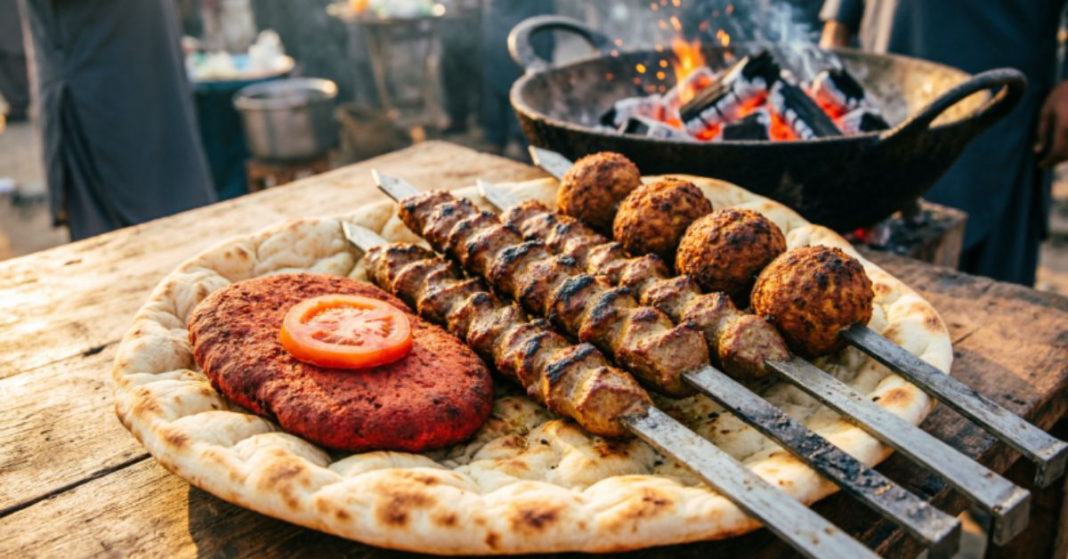

The physics of a perfect Pakistani kabab relies on the precise manipulation of protein structures, lipid distribution, and thermal conductivity. Stretching across the Kabab Belt from the salt forward, fat-rendered grills of Peshawar to the complex, spice-heavy marinades of Karachi the craft is less about recipes and more about the mastery of meat science. Achieving the Galawat secret (tenderization) requires a molecular understanding of how acids and enzymes break down connective tissue without compromising the meat’s integrity. Unlike Western patties, Pakistani kababs utilize high-velocity heat and specific fat ratios to create a pressurized internal environment, ensuring juices remain trapped within the seared exterior. This guide dissects the technical parameters required to replicate professional street-style results in a domestic or commercial kitchen, focusing on the chemical reactions that define the subcontinent’s most iconic exports.
What Makes Pakistani Traditional Kababs Unique?
Pakistani kababs are defined by the 80/20 meat-to-fat ratio, the use of Kikar (Acacia) charcoal, and the Dhungar (smoking) technique. Unlike regional variants, they prioritize high-fat emulsification and natural proteolytic tenderizers like green papaya or dried figs to achieve a “melt-in-the-mouth” texture while maintaining a charred, smoky exterior.
The Meat Science: Ratios, Grinding, and Lipid Dynamics

The foundation of a superior kabab is not the spice blend, but the cellular structure of the meat. To achieve the desired Smokey BBQ flavor at home, one must first master the raw materials.
The 80/20 Rule and Beef Suet Ratio
A lean kabab is a failed kabab. For Seekh and Chapli variants, a strict 80% lean meat to 20% fat ratio is the industry standard.
- Dunba Fat (Lamb Tail Fat): Essential for Northern (Pushtun) styles. It has a lower melting point, providing a silky mouthfeel.
- Beef Suet: Preferred for Karachi-style kababs. It provides structural stability, preventing the meat from falling off the skewer under high heat.
Cold-Grinding and Protein Binding
Heat is the enemy of raw mince. If the meat warms during the grinding process, the fat begins to smear and separate from the protein (breaking the emulsion).
- Chilling: Meat and fat must be near-freezing ($0^{\circ}C$ to $2^{\circ}C$) before entering the grinder.
- Grain Direction: Meat should be cut across the grain before grinding to shorten muscle fibers, resulting in a more tender bite.
- Kneading (The Malan): After grinding, the meat must be kneaded vigorously. This releases myosin, a protein that acts as a natural glue, ensuring the kabab adheres to the skewer without the need for excessive binders like flour.
Regional Hidden Gems: Beyond the Common Grill
While Seekh and Shami dominate global menus, the true technical prowess of Pakistani cuisine lies in its regional sub-variants.
1. Shikarpuri Kabab: The Lactic Acid Secret
Hailing from Sindh, the Shikarpuri Kabab utilizes a high-viscosity dahi (yogurt) marinade. The lactic acid in the yogurt provides a gentler, more uniform tenderization compared to fruit enzymes. This creates a tangy profile that cuts through the richness of the fat.
2. Chitrali Tikka: The Minimalist Physics
In the high altitudes of Chitral, the focus is on the purity of the meat.
- Ingredients: Only salt and animal fat.
- Science: The salt draws out surface moisture, allowing for an intense Maillard reaction, while the meat cooks in its own rendered fat. It is the ultimate test of meat quality.
3. Bihari Kabab: The Injeer (Dried Fig) Advantage

The Galawat secret of a Bihari Kabab is often attributed to papaya, but connoisseurs use Dried Figs (Injeer).
- Ficin vs. Papain: Figs contain ficin, an enzyme that breaks down collagen more selectively than the papain in papaya.
- Result: While papaya can turn meat “mushy” if left too long, injeer provides a tenderizing meat naturally process that maintains a distinct “thread-like” texture (Resha) in the beef.
Kabab Engineering: Solving Common Structural and Texture Gaps
Problem: Kababs Falling Off the Skewer
This is usually caused by excess moisture.
- Solution: Onions must be grated and squeezed dry in a muslin cloth before being added to the mince. Any residual water creates steam, which pushes the meat away from the metal skewer.
- Binding: If the meat is too lean, the lack of fat-binding will cause it to crumble. Ensure the Beef Suet ratio is maintained.
Problem: Excessive Shrinkage
Shrinkage occurs when the protein fibers contract too rapidly.
- Solution: Allow the marinated meat to “rest” for at least 6–8 hours. This allows the proteins to relax and the flavors to penetrate the cellular level. Additionally, avoid over-mixing once the salt is added, as salt strengthens protein bonds and can lead to a rubbery texture.
Achieving “Street-Style Smoke” (The Dhungar Technique)

To replicate the authentic aroma without an outdoor grill, use the Dhungar technique:
- Ignite a piece of Kikar (Acacia) coal until red hot.
- Place a small foil “boat” or an onion skin in the center of your cooked kabab bowl.
- Place the coal on the foil, drop a teaspoon of oil or ghee onto the coal, and immediately seal the lid.
- Trap the smoke for exactly 3 minutes. Any longer will result in a bitter, acrid taste.
The Tooling: Why Equipment Matters

The thermal properties of your cooking surface dictate the final texture.
- Cast Iron Tawas:
- These are essential for Chapli Kababs. Cast iron has high volumetric heat capacity, meaning it maintains a constant temperature even when cold meat is added. This ensures an instant sear, preventing juice leakage.
- Kikar (Acacia) Coal:
- This is the gold standard in Pakistan. Kikar burns at a consistent high temperature and releases a specific volatile organic compound (VOC) profile that defines the “Peshawari” aroma. It lacks the chemical aftertaste of commercial briquettes.
- Square Skewers:
- Professional Seekh Kababs use square skewers rather than round ones. The flat edges grip the meat, preventing it from spinning when the skewer is turned.
Technical Comparison of Major Kabab Types
| Kabab Type | Primary Meat | Key Spice/Agent | Texture | Best Pairing |
| Seekh | Beef/Lamb | Long Pepper (Pipli) | Springy & Juicy | Mint Chutney & Naan |
| Chapli | Beef | Dried Pomegranate (Anardana) | Coarse & Crispy | Afghani Naan |
| Shami | Beef/Mutton | Split Chickpeas (Chana Dal) | Silky/Fibrous | Pulao or Sandwich |
| Bihari | Beef Strips | Raw Papaya/Dried Figs | Melt-in-mouth | Paratha & Red Onion |
Low Calorie Kabab Hacks for Health-Conscious Foodies

You can maintain the Authentic Peshawari Masala profile while reducing the caloric density:
- Air-Frying: Use an air fryer at $200^{\circ}C$ to mimic the high-heat sear of a Tawa.
- Substitute Fat: Use 10% fat and 10% grated bottle gourd (Lauki). The vegetable provides moisture (mimicking fat) with significantly fewer calories.
- Oats as Binder: Replace breadcrumbs or flour with powdered oats to increase fiber content without altering the flavor profile.
Conclusion: The Heritage of Precision and the Future of the Kabab Belt
The traditional Pakistani kabab is not merely a culinary artifact; it is a profound testament to a centuries-old, intuitive understanding of thermodynamics, molecular biochemistry, and lipid dynamics. To master the grill is to respect the “Kabab Belt” a geographic expanse where the preparation of meat is treated with the same rigor as an engineering project.
As we have dissected, the transition from a raw protein mass to a succulent, street-style masterpiece relies on a series of calculated chemical reactions: the Maillard reaction for surface complexity, the proteolytic breakdown for texture, and the volatile aromatic infusion for that signature smoky soul.
FAQs (Technical Deep Dive)
1. Why use Green Papaya instead of Lemon for tenderizing?
Lemon is an acid that “cooks” the exterior of the meat (denaturation) but doesn’t penetrate deeply. Green papaya contains papain, a proteolytic enzyme that actually digests the tough collagen fibers, making it a true tenderizer rather than a surface marinade.
2. Can I use store-bought mince for Seekh Kababs?
Standard store-bought mince is often too coarse and has an inconsistent fat ratio. For professional results, ask your butcher for a “double-mince” (fine grind) with 20% kidney fat or suet integrated during the grind.
3. Why do my Shami Kababs get mushy?
This happens due to an incorrect ratio of meat to lentils or over-boiling. Ensure the water is completely evaporated before grinding the mix. The mixture should be dry enough to not stick to your hands.
4. How long can marinated kabab meat stay in the fridge?
If using enzymes like papaya or figs, do not exceed 1218 hours. The enzymes will eventually turn the meat into a paste, destroying the texture. Without enzymes, 24 hours is the peak for flavor penetration.
5. Why is Anardana (Pomegranate seeds) essential in Chapli Kababs?
Beyond flavor, Anardana provides “crunch” and a hit of acidity that balances the heavy fat content (rendered tallow) typically used to fry Chapli kababs. It acts as a palate cleanser within each bite.