


Your WAPDA bill crossed Rs. 8,000 last July and your ceiling fan ran 18 hours a day. You’re not alone. With electricity now costing Rs. 50-65 per unit across most Pakistani distribution companies, a single conventional fan running continuously costs roughly Rs. 1,800 to 2,400 per month. Multiply that by four rooms, and you’re looking at a fan only electricity bill exceeding Rs. 9,600 monthly. That number stings and it should, because it’s entirely avoidable.
This guide exists to give you the technical truth that showroom salesmen won’t share, informed by real community pain points from Pakistani engineering forums, Reddit Pakistan threads, and Quora discussions about inverter fan failures.
Quick Answer Box (Featured Snippet)
Best fan in Pakistan 2026: For maximum savings, a BLDC (Brushless DC) fan consuming 25-35W beats any conventional fan consuming 75 to 100W. Top verified picks are GFC Inverter Series, Royal BLDC, and SK Fan’s copper-wound models. Breakeven on price premium occurs within 8 to 14 months of daily use at current PKR/unit rates.
Who This Guide Is For: The Real Pakistani Buyer
You are likely a middle-class homeowner in Lahore, Faisalabad, Multan, or Karachi. You own a house or apartment with 3 to 5 rooms. You’ve already survived two summers of load-shedding and you run either a UPS, a solar system, or both. You’ve been burned once either by a fan that died within 18 months or by an “energy-saving” product that saved nothing. Your priority is durability first, savings second, and brand reputation third. This guide speaks directly to that mindset.
Section 1: The CMM vs. RPM Debate The Metric Salesmen Exploit

Walk into any fan shop in Lahore’s Hall Road or Karachi’s Saddar market, and the salesman will quote you RPM like it’s the only number that matters. It isn’t. RPM (Revolutions Per Minute) tells you how fast the blade spins. CMM (Cubic Meters per Minute) tells you how much air actually reaches your body.
Technically speaking, a fan running at 380 RPM with poor blade pitch and a narrow sweep will deliver less CMM than a fan running at 340 RPM with aerodynamically angled blades. Pakistani brands historically over-engineer RPM while neglecting blade geometry. The result is a fan that sounds powerful but creates minimal air circulation particularly devastating in the enclosed rooms typical of Pakistani urban construction.
What to verify: A quality 56-inch ceiling fan should deliver a minimum of 210 to 230 CMM at medium speed. Ask for the CMM specification sheet, not just the RPM figure. If the dealer can’t produce it, that tells you something.
Section 2: BLDC Technology The Physics Behind the Savings

Conventional ceiling fans in Pakistan use single-phase induction motors. These motors work on electromagnetic induction: alternating current creates a rotating magnetic field, which drags the rotor along. The problem is inherent inefficiency: induction motors experience significant slip loss (typically 5-8%), heat dissipation through resistive windings, and mandatory capacitor dependency. That capacitor, incidentally, is responsible for 60% of conventional fan failures in Pakistan’s voltage-fluctuating grid.
BLDC motors operate on an entirely different principle. The rotor contains permanent magnets. The stator windings are energized sequentially by an electronic controller, creating precise, commutated magnetic fields. Consequently, there is no slip loss, no starting capacitor, and no brushes generating friction heat. The result is 25-35W consumption versus 75-100W in conventional motors, a verified 65 to 70% reduction in energy draw.
In contrast to what many assume, BLDC fans are not simply “inverter fans with a remote.” The electronic driver board that controls commutation is the critical component. A quality driver board (typically from Texas Instruments or STMicroelectronics chipsets) provides stable operation between 130V to 270V crucial for Pakistani grid conditions where voltage swings between 180V-260V in a single afternoon.
Section 3: Insulation Class The Hidden Cause of “Hot Air” in June
This is the technical detail that virtually no Pakistani consumer knows, and no salesman will voluntarily explain. Electric motors are rated by insulation class, which defines the maximum temperature the winding insulation can withstand before degrading.
Class E insulation (the standard in budget Pakistani fans) has a maximum temperature rating of 120°C. Class B insulation handles up to 130°C. In Multan or Rahim Yar Khan during June and July, ambient temperatures hit 45 to 48°C. Your fan motor running 18+ hours daily generates its own heat. In a poorly ventilated room, motor temperatures can reach 80-90°C. A Class E motor running near its thermal limit begins to break down its winding varnish. As that insulation degrades, winding resistance increases, current draw rises, and the motor gets hotter. It’s a self-accelerating failure cycle.
Specifically, motors running near thermal limits also create a measurable “hot air” effect the motor housing itself heats the air immediately below it, reducing the effective cooling sensation by 2 to 4°C. Class B insulation with proper thermal management eliminates this phenomenon. When comparing fans, ask explicitly about insulation class. Brands like GFC now specify this on their technical datasheets.
Section 4: Bearings & Winding Where Cheap Fans Die
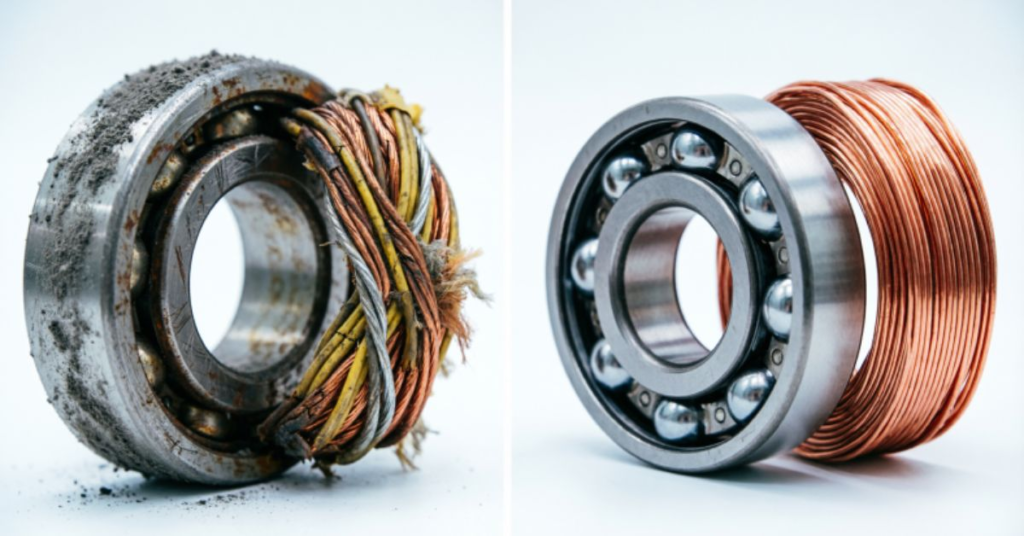
Two components determine fan longevity: the bearing system and the copper purity of the winding.
ZZ Shielded Bearings (double-sealed ball bearings) are the industry standard for fans rated for 3,000+ hours of continuous operation. Many budget Pakistani fans use open bearings or sleeve bearings. Open bearings accumulate dust and in Faisalabad’s cotton season or Lahore’s smog months, that dust accelerates wear dramatically. Within 2-3 years, this manifests as the wobble and grinding noise that Pakistani consumers universally recognize.
Regarding copper purity: winding wire rated at 99.9% pure copper (ETP copper) maintains consistent resistance across temperature ranges. Aluminum-substitute windings or low-purity copper alloys show 15-20% higher resistance at operating temperature, meaning more heat generation and higher electricity consumption than rated. Notably, some mid-tier Pakistani brands use copper-clad aluminum (CCA) wire while marketing the product as “pure copper wound.” The test: a magnet will not attract pure copper. CCA wire shows slight magnetic response due to the aluminum core.
Section 5: Community Pain Points Reddit Pakistan & Quora Answers

The Ticking Sound Problem: This is the most commonly reported issue in Pakistani inverter fan communities. The ticking sound in BLDC fans originates from the PWM (Pulse Width Modulation) frequency of the driver board interacting with the motor stator at certain speed settings. It’s not a defect, it’s a frequency resonance issue. The solution is straightforward: fans with driver boards operating at 20kHz+ PWM frequency push the ticking into the ultrasonic range, making it inaudible. When purchasing, request the driver board PWM specification. Alternatively, the Dual-Control feature (both remote and manual rotary switch) allows speed fine-tuning to avoid resonant frequencies.
Remote Failure Issues: Pakistani users report remote failures within 6-18 months at a significantly higher rate than other markets. The reason is humidity combined with voltage spikes. Remotes use IR receivers that are sensitive to humidity ingress. Brands offering RF-based remotes (radio frequency rather than infrared) show substantially better durability in Karachi’s coastal humidity. Additionally, ensure the fan you purchase has full manual control capability independent of the remote remote failure should never render your fan inoperable.
Section 6: The UPS/Solar Conflict Sine Wave vs. Square Wave
This is where thousands of Pakistani consumers unknowingly damage their BLDC fans annually. Conventional UPS systems in the Rs. 15,000 to 35,000 price range output modified square waves (sometimes marketed as “quasi-sine wave”). BLDC fans with sensitive electronic driver boards are designed for pure sine wave input. Running a BLDC fan on a modified square wave UPS causes the driver board to overheat, creates harmonic distortion in the motor, and can reduce driver board life from 8-10 years to 2-3 years.
The practical solution: Either use a pure sine wave UPS (Homage Inverter Pro, AGS Infinity series) or connect your BLDC fans on your solar direct circuit if your solar inverter outputs pure sine wave which virtually all grid-tie and most hybrid inverters do. Specifically, verify your UPS documentation for “Output Waveform: Pure Sine Wave” before running BLDC fans on it.
Section 7: Financial ROI The Exact Breakeven Calculation

| Parameter | Conventional Fan | BLDC Fan |
| Rated Wattage | 100W | 30W |
| Daily Hours | 18 hrs | 18 hrs |
| Daily Units | 1.8 kWh | 0.54 kWh |
| Monthly Units | 54 kWh | 16.2 kWh |
| Monthly Cost (Rs. 55/unit) | Rs. 2,970 | Rs. 891 |
| Monthly Saving | — | Rs. 2,079 |
A quality BLDC fan in Pakistan costs Rs. 14,000 to 22,000 versus Rs. 3,500 to 6,000 for a conventional fan. The price premium is approximately Rs. 12,000-16,000. At Rs. 2,079 monthly saving per fan, the breakeven point falls between 6-8 months of full summer usage or 10 to 14 months if you account for seasonal variation. After breakeven, each fan generates Rs. 2,000+ in net savings monthly for its entire operational life.
For a 4-fan household, lifetime savings over 8 years exceed Rs. 750,000 against an additional upfront investment of Rs. 60,000-65,000.
Section 8: Brand Comparison Unbiased Technical Assessment

GFC (General Fan Company): Pakistan’s most established manufacturer. Strengths include genuine after-sales service network across 25+ cities and documented Class B insulation in their premium range. Real world air throw-in independent tests rates are consistently high. Weakness: their entry-level BLDC range uses imported driver boards with limited local serviceability.
Royal Fan: Strong build quality with heavy-gauge steel housings. Their copper winding quality is verifiable and consistent. In contrast, their remote control reliability has drawn criticism in Karachi-based user communities; the IR receivers show humidity sensitivity.
Khurshid Fan: Offers the most aggressive pricing in the BLDC segment. Service network quality varies significantly by city, excellent in Lahore, inconsistent in secondary cities. Their aerodynamic blade design, notably their “Aero Sweep” profile, delivers competitive CMM figures for the price point.
SK Fan: Strongest reputation specifically in the Faisalabad industrial belt where fan expertise runs deep. Build material quality is arguably the best in the domestic market. The weakness is limited retail availability outside Punjab and a premium price that extends the breakeven timeline by 2-3 months.
Final Verdict
For most Pakistani homeowners in 2026, the GFC Inverter Series or SK Fan BLDC models represent the optimal combination of technical quality, service network, and financial return. Prioritize CMM over RPM, verify pure sine wave compatibility with your UPS, and confirm Class B insulation and ZZ bearing specifications before purchase. The premium is real and so is the payback.
FAQs
Q1: Can a BLDC fan circuit be repaired locally if the driver board fails?
Driver boards in GFC and Royal fans use standard components available in Lahore’s Hall Road and Karachi’s Saddar electronics markets. A competent local electrician can replace individual MOSFETs and capacitors for Rs. 800-1,500. However, the microcontroller IC often requires brand-specific programming for this, use the brand’s authorized service center.
Q2: Are BLDC fans compatible with conventional dimmers?
No. Conventional TRIAC based dimmers create the same modified waveform problem as square wave UPS systems. BLDC fans require their own electronic speed controller (supplied with the fan). Installing a conventional dimmer will damage the driver board within weeks.
Q3: Does dust accumulation on blades significantly affect performance?
Yes measurably so. A 2mm dust layer on blade surfaces increases aerodynamic drag and reduces effective CMM by 8 to 12%. In Lahore and Faisalabad, clean fan blades every 6-8 weeks during summer. Use a dry microfiber cloth; wet cleaning risks humidity ingress into the motor housing.
Q4: Can a BLDC fan run directly on solar panels without an inverter?
Some BLDC fans are marketed as “DC direct” compatible, but standard Pakistani BLDC fans require regulated AC input from an inverter. Running directly from panels without an inverter causes voltage fluctuation damage. Use a solar inverter with pure sine wave output as the intermediary.
Q5: How do warranty claims actually work in Pakistan for these fans?
GFC and Royal both offer 2 year warranties with claims processed through authorized dealers. Keep your original purchase receipt without it, warranty claims are routinely rejected. For cities without authorized service centers, brands typically arrange courier-based repair, though turnaround is 2-3 weeks. Document any defect with video immediately upon discovery; this significantly strengthens your claim.