
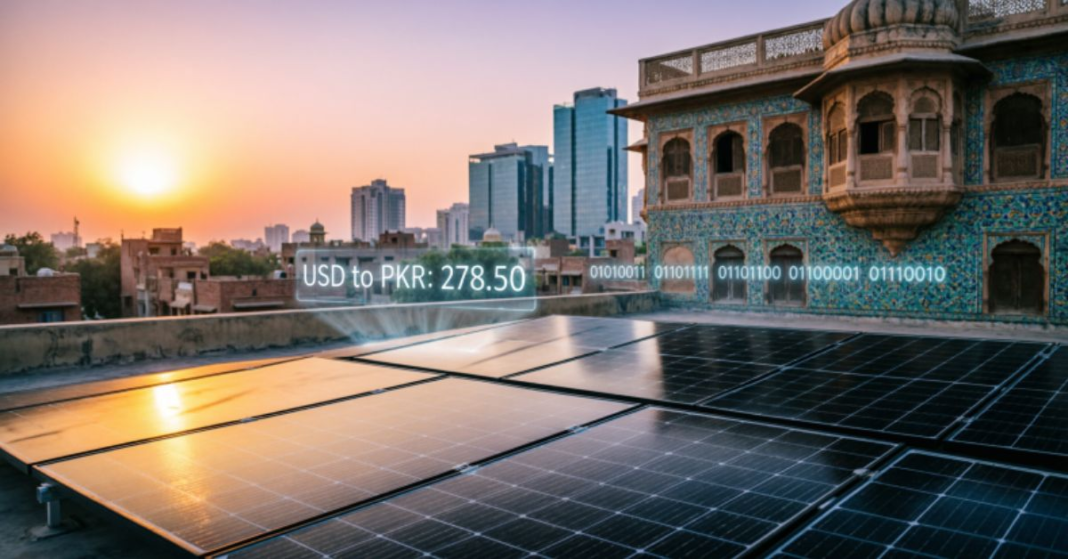

Pakistan’s economy in 2026 is a tale of two realities. On one side, inflation is squeezing household budgets, the rupee remains under persistent pressure, and the cost of running a traditional business has never been higher. On the other side, a new generation of Pakistani entrepreneurs is quietly building dollar-earning agencies, launching solar service firms, and exporting branded products to Europe and North America all from their homes and small offices. This guide is written for both sides of that story. Whether you are a Gen-Z hustler with PKR 20,000 and a laptop, a corporate professional ready to bet on yourself, or an overseas Pakistani looking for a reliable asset back home the pages ahead contain a structured, legally sound, and realistic roadmap built specifically for Pakistan’s 2026 economic landscape. No fluff. No shortcuts. Just three business models that actually work.
Quick Answer: Best Businesses in Pakistan Right Now
Google Featured Snippet Summary: In 2026, the best businesses in Pakistan are dollar-pegged services, specifically AI Workflow & Automation Agencies, Solar Maintenance Firms, and Export Ready Value Added Agri Products like Himalayan Pink Salt. These three models survive rupee devaluation, scale with minimal capital (starting from PKR 20,000), and solve real-world Pakistani market gaps today.
Pakistan 2026: Before You Read One More Business Tip, Read This
Electricity bills have doubled. The rupee hovers under pressure. Inflation has quietly eaten into savings that took years to build.
And yet somehow a quiet revolution is happening in parallel.
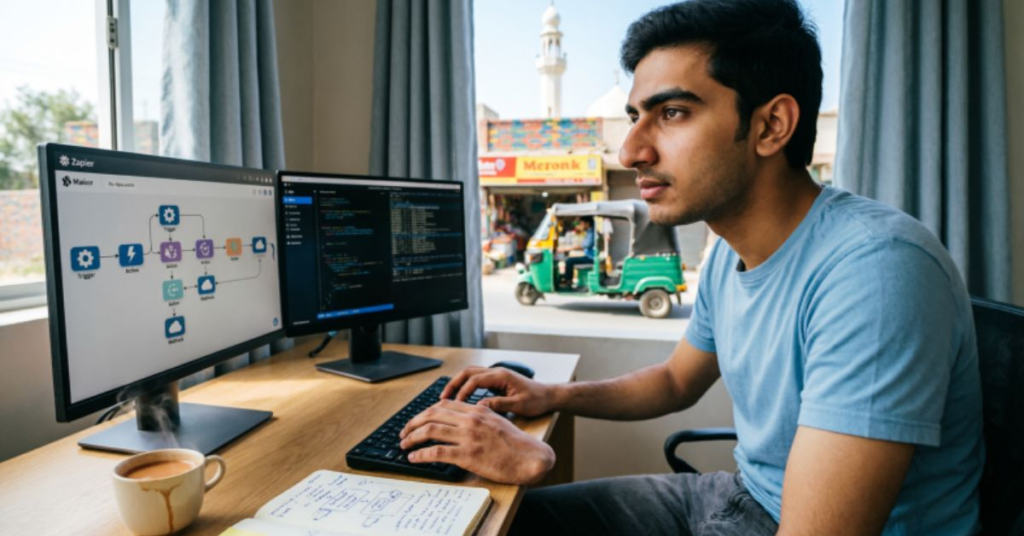
Pakistani freelancers are collectively earning over $400 million in foreign exchange annually. Solar installations have crossed 10 gigawatts nationwide. A 24 year-old in Lahore is building Zapier automations for a dentist in Texas, invoicing in dollars, and converting at 280 to 1. A former bank manager in Karachi launched a solar panel cleaning service, registered it properly with SECP, and now has five technicians on his payroll.
This is not a motivational story. This is the economic reality of Pakistan in 2026 brutal in its inflation, but surprisingly fertile for those who know where to plant.
This guide is not going to tell you to “start a YouTube channel” or “dropship from China.” Those windows have either closed or are far more competitive than any blogger will admit. Instead, we are going to walk you through three specific, legally sound, scalable business models with real numbers, real hurdles, and real solutions to Pakistan’s unique obstacles: payment gateways, seed money paradoxes, and the registration bureaucracy that sends most people running.
Whether you have PKR 20,000 or PKR 10 Lakh or you are an overseas Pakistani looking to deploy capital back home there is a path here for you. Let’s navigate it together.
The Legal Framework: How to Make Your Business Real (and Protect Yourself)
Most business guides skip this section entirely. That is a disservice to you. In Pakistan, operating informally feels easier until you need a bank account for your business, a payment gateway, or a contract with an international client. Suddenly, you need to be “real.” Here is exactly how to become real, without a lawyer charging you PKR 50,000 for advice you can do yourself.
Step 1: Obtain Your NTN (National Tax Number) Free, Online, 48 Hours
- Visit the FBR IRIS portal at iris.fbr.gov.pk
- Register as an ‘Individual’ if you are a sole proprietor no need for company registration at this stage
- Required documents: CNIC copy, bank account number, proof of business address (a utility bill works)
- NTN is issued within 24 48 hours digitally
- Cost: PKR 0. It is completely free.
- Why it matters: You need this for any formal bank account, for filing your annual returns (which keeps you off the tax filer blacklist), and for many payment gateway applications
Step 2: SECP Registration For Those Scaling Beyond Freelancing
If you are building a proper company (to attract investors, hire formally, or sign international contracts), the Securities and Exchange Commission of Pakistan (SECP) is your next stop.
- Go to eservices.secp.gov.pk
- Choose ‘Single Member Company (SMC)’ if you are solo the most founder-friendly structure in Pakistan
- Reserve a company name (takes 24 hours to approve)
- File Form 1 (Memorandum & Articles of Association) templates are available on SECP’s website
- Total cost: Approximately PKR 1,500 to 3,500 in government fees
- Timeline: 5 7 business days for full incorporation certificate
- Once incorporated: Open a dedicated business bank account at HBL, Meezan, or UBL mandatory for Payoneer/SadaBiz business account verification
Step 3: Solving the Payment Gateway Problem
This is the single most-asked question on Pakistani Reddit and Quora threads about online business: “How do I receive dollars?” Here is the honest, 2026-accurate answer:
| Platform | Best For | Key Limitation in Pakistan |
| Payoneer | Freelancers, agencies, Upwork withdrawals | PKR payout via HBL/Meezan; USD held in wallet withdraw within 3–5 days |
| SadaBiz | Pakistani SMEs, e-commerce, local + international receiving | Newer platform limited international merchant integrations vs Stripe |
| Wise | Consultants invoicing EU/US clients directly | Requires foreign entity or partner country address for full functionality |
| Local Bank USD Account | Export businesses, government registered entities | Requires export documentation; not ideal for pure service businesses |
Pro Tip: The most frictionless path in 2026 is: NTN + Meezan Bank business account + Payoneer verified as a business. This combination is accepted by 90%+ of international freelance clients and marketplace platforms.
Niche #1: AI Workflow & Automation Agency The Rs. 20,000 Dollar Machine
The Opportunity Nobody Is Talking About Loudly Enough
Here is a number that should stop you mid-scroll: there are approximately 33 million small businesses in the United States alone. The vast majority of bakeries, law firms, dental offices, real estate agencies, boutique gyms are still managing their customer follow ups via WhatsApp, their invoicing via Excel, and their social media by hand. They know AI exists. They have heard of ChatGPT. They have no idea how to make it work for their specific business.
That gap is your business.
An AI Workflow & Automation Agency charges these businesses anywhere from $300 to $2,500 per month as a retainer to build and maintain systems using tools like Zapier, Make (formerly Integromat), n8n, and GPT-4 API. You are not building custom software. You are connecting tools that already exist, customizing prompts, and saving business owners 10-20 hours per week. This is a service business meaning low capital, high margin, and scalable through reputation.
Why Pakistan Wins at This Game
- Cost arbitrage: You charge in USD, live on PKR costs. A $500/month retainer equals PKR ~140,000+ more than the average corporate manager’s salary in Karachi
- Time zone advantage: Pakistan Standard Time (PKT, UTC+5) allows morning overlap with European clients and evening delivery for US East Coast clients
- Existing tech talent: Pakistan ranks in the top 5 globally on Upwork for tech freelancing the ecosystem of mentors, communities (like PakFreeWork and Dev.pk Slack), and case studies already exists
How to Start With PKR 20,000 to 50,000
- Month 1 (PKR 0 to 5,000): Learn Zapier fundamentals (zapier.com/learn free), complete at least 2 Make.com tutorials, and practice by automating something in your own life
- Month 2 (PKR 5,000 to 15,000): Build 2 to 3 portfolio automations for local small businesses for free or at a massive discount a bakery’s order management, a tuition center’s fee reminder system, a clothing brand’s Instagram DM auto reply
- Month 3 (PKR 20,000 to 50,000): Create profiles on Upwork and Contra.com. Contra is especially powerful for Pakistani freelancers because it charges 0% commission. Write proposals targeting US/UK small business owners who have job posts about “repetitive tasks,” “workflow,” or “business automation”
- Target monthly revenue milestone (Month 6): $1,000 to 2,000/month from 2 to 4 retainer clients
The Real Hurdles (And How to Cross Them)
- Hurdle #1 “They won’t trust a Pakistani agency”: This bias exists. Counter it by positioning as an individual expert first (not an “agency”), building English language case studies with concrete ROI metrics (“Saved 12 hours/week for a Miami dental clinic”), and using Loom videos to walk clients through your work
- Hurdle #2 “I don’t know what to charge”: Start at $25 to $40/hour or $300/month flat retainer. Once you have 3 positive reviews on Upwork, raise it to $50 to 75/hour. Many top Pakistani automation freelancers charge $100+/hour within 18 to 24 months
- Hurdle #3 Payment receiving: Payoneer linked to your Meezan business account. Upwork pays directly to Payoneer. Non-platform clients can pay via Wise to Payoneer. Both work in Pakistan in 2026
Niche #2: Solar Maintenance & Audit Firm The Business the Electricity Crisis Built
Pakistan’s Solar Paradox
Between 2022 and 2025, Pakistan witnessed one of the fastest residential solar adoption rates in South Asia. Driven by electricity bills reaching PKR 80 to 120 per unit in urban areas and frequent 8-12 hour loadshedding in smaller cities, families and businesses rushed to install solar panels. Pakistan’s total installed solar capacity crossed 10 GW, a remarkable feat.
Here is the problem nobody planned for: who is going to maintain all of it?
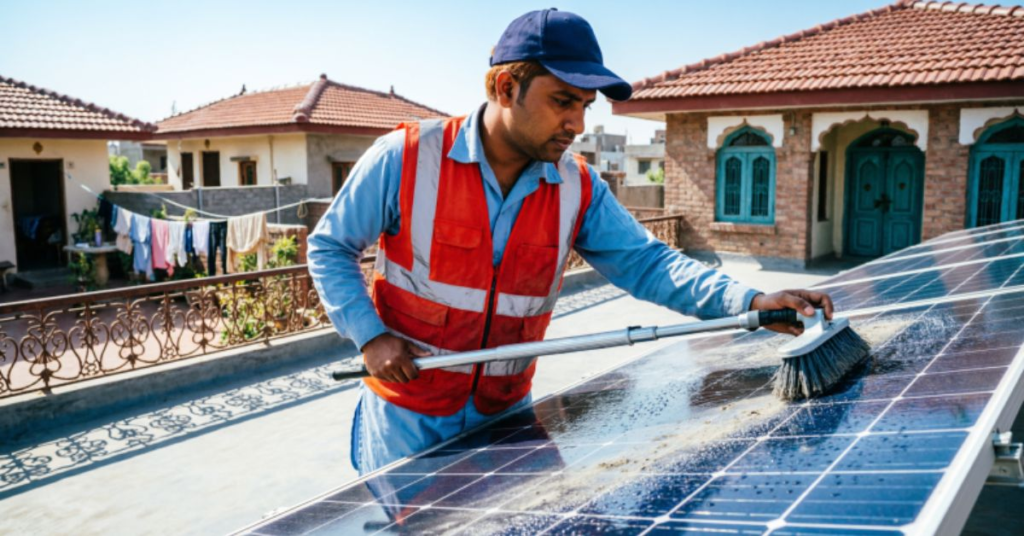
Dust accumulation alone can reduce a solar panel’s efficiency by 15 to 30% within 4-6 weeks in Pakistani climates, especially in Punjab and Sindh. Faulty inverter settings, improper panel angles, degraded connectors, these issues are silently bleeding thousands of rupees from families who believed they had escaped the electricity grid. And the “solar companies” that installed the panels? Most of them were distributors, not service companies. They are not coming back to clean, audit, or repair.
That vacuum is your business opportunity.
Service Line 1: Residential Solar Panel Cleaning
- Service: Professional cleaning using deionized water and soft-bristle equipment (deionized water prevents streaking and mineral deposits that regular water leaves)
- Pricing: PKR 2,500 to 5,000 per visit for a 5 to 10 panel residential system. Monthly maintenance contracts: PKR 3,500 to 8,000/month
- A single technician can complete 3 to 4 residential visits per day in the same neighborhood, generating PKR 7,500 to 20,000/day in revenue
Service Line 2: Solar System Audit & Performance Report
- Service: A 90-minute audit checking panel efficiency (clamp meter + irradiance meter), inverter settings, battery health, and cable integrity
- Pricing: PKR 5,000 to 12,000 per audit with a written report and actionable recommendations
- Upsell: Replacement of faulty components at a markup (partner with a solar distributor for trade pricing on inverters, connectors, and MC4 cables)
Investment Breakdown
| Equipment / Expense | Estimated Cost (PKR) |
| Deionized water system (portable, 20L tank) | 12,000 to 18,000 |
| Soft cleaning brushes, extension poles | 5,000 to 8,000 |
| Clamp meter (for audit services) | 8,000 to 15,000 |
| Safety harness + rooftop equipment | 6,000 to 10,000 |
| Business registration + branding (printed) | 8,000 to 15,000 |
| Total Startup Investment | PKR 39,000 to 66,000 |
Scaling the Business
The corporate and industrial market is where this business truly scales. Commercial solar installations (factories, shopping malls, hospitals, schools) have 50 to 500 panels each. A single annual maintenance contract with a factory can be worth PKR 200,000 to 500,000/year. Pursue these contracts by:
- Registering with SECP as an SMC and obtaining a basic business registration certificate
- Approaching industrial estate management offices in SITE (Karachi), Faisalabad Industrial Estate, and Lahore’s Quaid-e-Azam Industrial Park directly with a formal proposal
- Partnering with solar installation companies as their “official after-sales maintenance partner” to they get a revenue share, you get a steady referral stream
- 6-month revenue projection (1 technician): PKR 150,000 to 250,000/month from residential cleaning contracts + 1 to 2 industrial audit clients
Niche #3: Export-Ready Value Addition Pink Salt & Agri Products
The Raw Material Trap Pakistan Has Been Stuck In
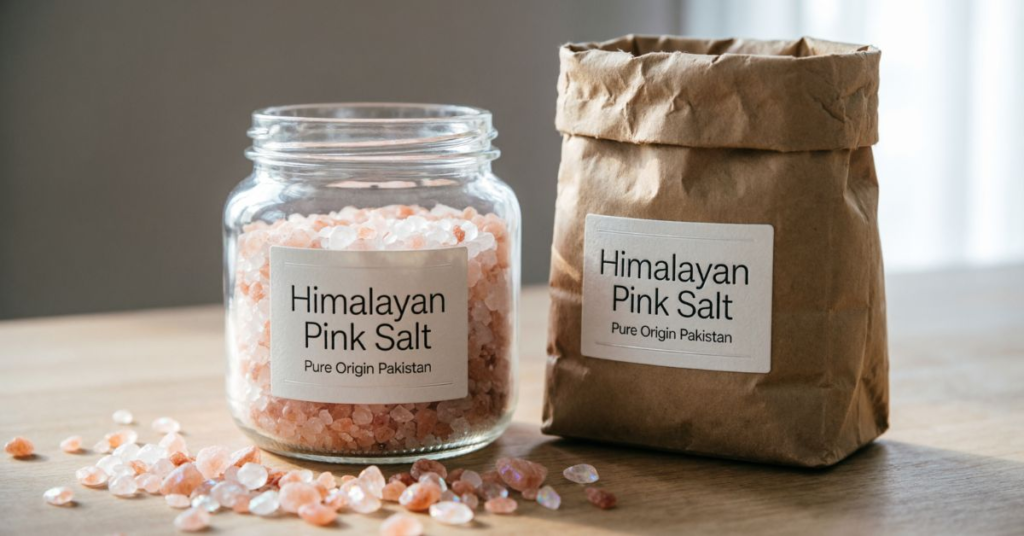
Pakistan is one of the world’s largest exporters of raw Himalayan Pink Salt. The Khewra Salt Mine in Punjab produces millions of tonnes annually, and most of it leaves Pakistan as unprocessed, unbranded rock. The international buyer, a retailer in Germany, a health food brand in California then grinds it, packages it in beautiful jars with “Himalayan” printed in elegant fonts, and sells it for $12 to $18 per 500g jar. Pakistan receives the export price of approximately $0.10 to 0.30 per kilogram of raw salt.
The margin that Pakistan is leaving on the table is staggering. And this same pattern repeats across dozens of Pakistani exports: raw mangoes, raw cotton, raw leather hides, raw chilies.
The online business in Pakistan 2026 opportunity is not just to “start exporting.” It is to add value to be the company that grinds, blends, brands, packages, and tells the story before the product leaves Pakistan.
The Himalayan Pink Salt Value Chain: Step by Step
- Source: Buy raw salt from Khewra distributors or Salt Range producers in Punjab. Bulk price: PKR 80 to 150/kg for food-grade fine/coarse salt
- Process: Grind to multiple grades (coarse, fine, extra-fine). Optional: create herbed salt blends (Himalayan salt + dried garlic + rosemary) to these command 3x premium pricing internationally
- Package: Use food-grade kraft pouches or glass jars with professionally designed labels. Packaging cost per unit: PKR 80 to 200 depending on material
- Certify: Obtain PSQCA (Pakistan Standards and Quality Control Authority) food-grade certification. Required for export to EU/US. Cost: PKR 15,000–35,000 for initial lab testing
- Sell: List on Amazon.com (USA) via Amazon FBA or Amazon Global Selling (AGS). Pakistan-origin sellers can now register for AGS with a Pakistani business address. Alternatively: Etsy for artisan/small-batch positioning, or direct wholesale to European health food distributors via email outreach
Economics That Make Sense
- Raw material cost per 500g unit (packaged): PKR 180 to 350 (salt + packaging + label)
- Amazon/Etsy selling price (USD): $8 to 15 per 500g unit
- After platform fees (15%) and shipping: Net revenue of $5 to 10 per unit = PKR 1,400 to 2,800
- Gross margin per unit: PKR 1,050 to 2,450 (approximately 75 to 85% gross margin at scale)
The Startup Cost Reality
- Minimum viable test (100-unit batch): PKR 80,000 to 120,000 including raw salt, packaging, lab testing, branding design, and Amazon seller account fee ($39.99/month)
- Ideal business for the Overseas Pakistani profile invest PKR 5 to 10 Lakh, hire 2 3 people in Punjab for production and packaging, manage the Amazon store remotely from Dubai or the UK
- For the Corporate Escapee profile: start with a 500 unit batch, use the first 90 days to iterate on packaging and listings before scaling production
Beyond Salt: The Agri-Tech Angle
The same value-addition framework applies to future startups across Pakistan’s agri space:
- Dehydrated mango powder and slices (Sindhri and Chaunsa are globally prized varieties)
- Kashmiri red chili powder (higher capsaicin content than Mexican chili, commanding premium in specialty markets)
- Cold-pressed moringa oil (KPK region grows significant moringa)
The common thread is always certification, branding, and direct-to-consumer e commerce not broker-to-broker bulk trade.
The Scalability Matrix: Compare Before You Commit
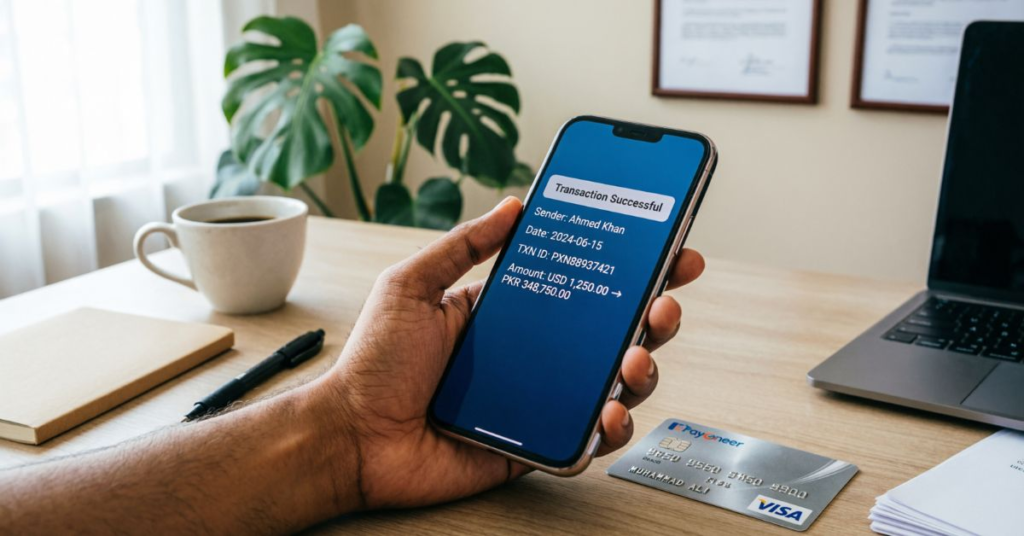
Before you choose your path, here is an objective comparison of all three models. Scores are out of 10.
| Metric | AI Automation Agency | Solar Maintenance Firm | Export Value Addition |
| Min. Investment | PKR 20,000 to 50,000 | PKR 40,000–70,000 | PKR 80,000–150,000 |
| Rupee Devaluation Risk | Very Low (USD revenue) | Low (PKR, necessity service) | Very Low (USD/EUR revenue) |
| Scalability Score | 9/10 | 7/10 | 8/10 |
| Skill Barrier | Medium (3 to 6 months learning) | Low-Medium (technical training) | Low (process-based) |
| Passive Income Potential | 7/10 (retainer model) | 6/10 (annual contracts) | 9/10 (Amazon FBA autopilot) |
| Risk Score (1=Low) | 2/10 | 3/10 | 5/10 |
| Exit Strategy | Sell client contracts (Flippa/Acquire.com) | Sell as operating business (SMEDA platform) | Sell Amazon brand (Empire Flippers, 2–4x annual profit) |
| Best Fit ICP | Gen-Z Hustler | Corporate Escapee | Overseas Pakistani |
Note on Exit Strategies: Most business guides never mention this. But knowing how you can eventually sell or transfer your business affects every decision from day one: your naming conventions, your documentation habits, your client contract structures. Build to sell-ready standards from the beginning, even if you never want to sell.
A Final Word: The Inflation-Proof Mindset
Pakistan’s economic conditions in 2026 are difficult. We are not going to pretend otherwise. Electricity costs are painful. The rupee’s purchasing power requires constant recalibration. Bureaucracy still has friction. These are facts.
But here is another fact: every single economic pressure Pakistan faces right now is creating a business opportunity somewhere in the value chain.
- High electricity costs → exploding solar adoption → solar maintenance business gap
- Rupee devaluation → dollar-earning skills become extraordinarily valuable
- Bureaucracy fear → most competitors never formalize → first-mover advantage for those who do
The entrepreneurs who will look back at 2026 as their inflection year are the ones who refused to wait for conditions to improve before they started. They are building in the chaos, not waiting for the calm.
You now have the roadmap from NTN registration to payment gateway solutions, from your first PKR 20,000 to your first dollar-denominated retainer client. The next move belongs to you.
FAQs: The 5 Questions Pakistani Entrepreneurs Actually Ask
Q1: Can I really receive dollar payments from Pakistan? Is it legal?
Yes, completely legal. Pakistan State Bank (SBP) actively encourages foreign exchange inflows through freelancing and service exports. Under SBP’s Roshan Digital Account and
standard home remittance rules, receiving USD payments for services rendered to foreign clients is not only legal but tax-advantaged (service exporters who are filers are entitled to reduced withholding tax rates).
The mechanism: international client pays to your Payoneer or Wise account → you withdraw to your Pakistani bank account as a PKR inward remittance. Ensure you declare it in your annual FBR return this keeps you on the active filer list, which itself has significant financial benefits (lower WHT on bank transactions, property purchases, vehicle registrations).
Q2: I only have PKR 50,000. Where should I literally start today?
- Week 1: Complete NTN registration (free, online, 48 hours). Open a Meezan Islamic Current Account in your business name (minimum balance: PKR 5,000). Apply for a Payoneer business account.
- Week 2–4: Spend PKR 0 learning Zapier (free tier available). Build 2 automation projects for free for local businesses document the before/after with numbers.
- Month 2: Create Upwork and Contra.com profiles. Invest PKR 10,000 in a professional profile photo, a portfolio website (Carrd.co at $9/year), and Grammarly Premium (for proposal writing).
- Month 3: Your first $100 to 300 client. Reinvest 50% into tools (Make.com subscription, AI API access), save 50%.
The seed money paradox is real but solvable: the AI automation path requires PKR 20,000 to 50,000 maximum to become legitimately operational. The “I need money to make money” cycle breaks when the product you are selling is a skill, not inventory.
Q3: I am afraid of the legal/tax system. How do I avoid getting into trouble?
The fear is understandable but overestimated. For 95% of small business owners and freelancers, Pakistan’s tax compliance requirement is simply:
- File your annual return with FBR by September 30th
- Declare your income
- Pay the applicable tax
In your first year, as an individual with NTN income under PKR 600,000, your income tax liability is PKR 0 (see current FBR income tax slabs). Between PKR 600,000 to 1,200,000, the rate is 2.5%. This is manageable.
The danger zone is not paying taxes it is being a non-filer. Non-filers pay 2x the withholding tax on virtually every financial transaction in Pakistan. Being a compliant filer is financially beneficial, not just legally required.
Q4: What about small investment big profit business options that are purely domestic (not export-focused)?
Valid question. For those whose primary market must be Pakistan:
- (a) Tiffin/Meal Prep Services targeting young professionals in co-working spaces in Islamabad/Lahore/Karachi food businesses with PKR 30,000–50,000 startup costs have proven demand
- (b) Academic tutoring aggregation creating a WhatsApp-based, Instagram-marketed home tuition service connecting certified tutors to families. No inventory, minimal tech requirements
- (c) Domestic cleaning services targeting upper-middle-class areas in DHA and Bahria Town clusters the domestic equivalent of the solar maintenance model
These are solid, inflation-resistant businesses because people always need food, education, and clean homes regardless of macroeconomics. That said, they do not provide the rupee devaluation hedge of dollar-pegged businesses.
Q5: How do I know when my business is ready to scale (or sell)?
- AI Automation Agency: Ready to scale when you have 3+ retained clients paying $300+/month with signed 6-month contracts. Hire a Pakistani sub-contractor (via Rozee.pk or LinkedIn) at PKR 60,000 to 80,000/month to handle delivery while you focus on sales. Sellable on Acquire.com or Flippa when you have 12+ months of consistent revenue and documented SOPs.
- Solar Maintenance Firm: Scalability trigger is 2+ corporate annual maintenance contracts signed. Hire and train a second technician, document protocols in a physical manual. Sellable when it operates without you for 30+ days.