
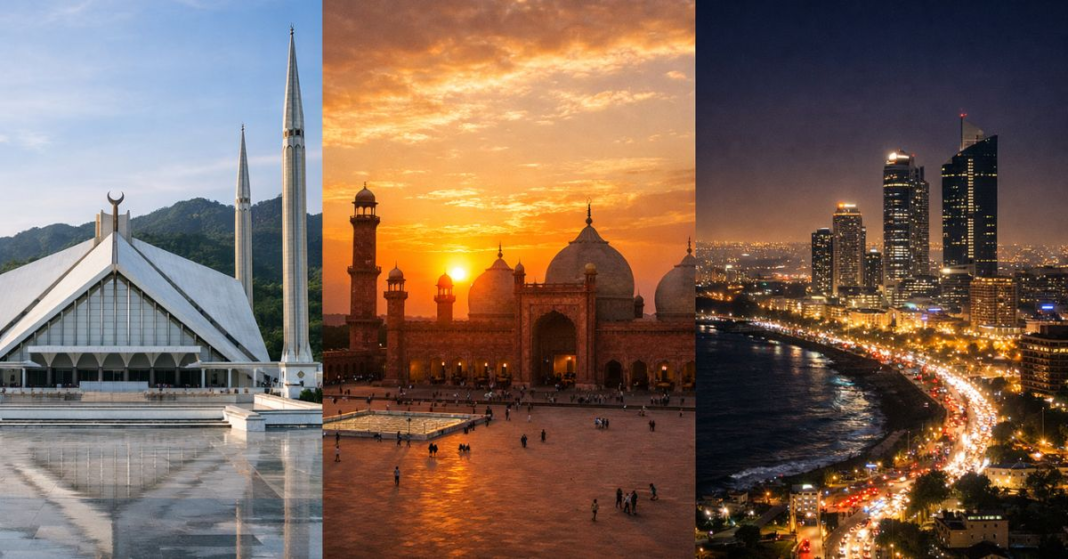

Ask ten Pakistanis which city is best and you’ll get eleven opinions, two from the Lahori who can’t stop talking about nihari.
The truth? There is no single “best city in Pakistan.” There is only the best city for you your income goals, your lungs, your kids’ school fees, and your tolerance for 3-hour traffic jams. This guide cuts through the biryani-vs-paye tribal warfare and gives you cold, actionable data.
Whether you’re a freelancer hunting fiber internet, an overseas Pakistani scouting real estate investment in Pakistan, or a young family looking for safe neighborhoods and top-tier schools this is the only guide you need
Quick Answer Box
What is the best city in Pakistan? It depends on your goal. Islamabad wins for safety, air quality, and digital infrastructure. Lahore leads for business, culture, and connectivity. Karachi dominates for income and opportunity. Abbottabad and Sialkot are the underrated gems for families and investors in 2026.
The Factors Nobody Talks About (But Should)
The AQI Reality: Breathing Is a Utility Too

This is the single most underreported livability factor in Pakistan.
Lahore consistently ranks among the top 5 most polluted cities on Earth during winter months (November–February). In 2025, Lahore’s AQI regularly crossed 400 to 500 (Hazardous) during peak smog season. That’s not inconvenient, that’s a public health emergency.
Islamabad sits at an average AQI of 50 to 80, which is “Moderate” by WHO standards. Abbottabad and Murree hover around 20 to 40 clean enough that your morning run won’t feel like a cigarette.
For young families and anyone with respiratory conditions, AQI is a dealbreaker metric, not a footnote.
Verdict: If you have children under 10 or any respiratory condition, Punjab cities carry a measurable health cost that no salary bump fully compensates.
Digital Infrastructure: Fiber-to-the-Home (FTTH) & 5G

For Pakistan’s growing freelancer economy projected at $500M+ in annual exports by 2026 internet quality is as critical as electricity.
- Islamabad: Best FTTH penetration in the country. StormFiber, Nayatel, and Transworld cover most of F, G, E, and I sectors. Median speeds: 80–150 Mbps. 5G trials are active in select sectors.
- Lahore: Strong fiber coverage in DHA, Gulberg, Johar Town, and Bahria Town. Multiple ISPs compete, keeping prices competitive. Average speeds: 50–100 Mbps.
- Karachi: Fiber coverage is improving but uneven. DHA and Clifton have solid options; older neighborhoods rely on HFC or DSL. 5G rollout is ahead of schedule.
- Faisalabad & Sialkot: Fiber availability is growing rapidly StormFiber has aggressively expanded into Tier-2 cities. Good for remote workers willing to do some ISP homework.
- Peshawar & Quetta: FTTH is still limited to select areas. Reliable connectivity requires a backup LTE solution.
For freelancers and digital nomads: Islamabad is the gold standard for digital infrastructure in Pakistan right now.
The Solar ROI Factor: Which City Makes Solar Worth It

With 8–10 hour load-shedding still affecting Tier-2 and Tier-3 cities, solar has gone from a luxury to a financial decision.
Solar ROI depends on Peak Sun Hours (PSH) and your electricity tariff. Here’s the breakdown:
- Quetta & Balochistan: 5.5–6.5 PSH daily highest in Pakistan. A 10kW system pays itself back in 3–4 years. Exceptional solar value.
- Karachi: 5.0–5.8 PSH. Very strong solar returns, especially with K-Electric’s net-metering policy.
- Islamabad/Rawalpindi: 4.5–5.2 PSH. Solid returns, typically 4–5 year payback.
- Lahore & Faisalabad: 4.2–5.0 PSH. Good ROI, but winter smog reduces panel efficiency by 10–20% during peak smog months a factor most solar salespeople won’t mention.
- Abbottabad & Northern Cities: Lower PSH (3.5–4.5) due to cloud cover. Solar is viable but less aggressive in returns.
Best city for solar investment: Quetta and Karachi. If you’re investing in real estate in Pakistan with solar, southern and western Pakistan maximizes your energy returns.
Water & Utilities: The Hidden Monthly Cost

This one hits your wallet silently.
Karachi: The city runs on a partially broken KWSB water supply. Water tankers cost Rs. 1,200–2,500 per tanker in many areas, with households spending Rs. 5,000–15,000/month on water alone. This cost almost never appears in “cost of living” comparisons but it’s real and it’s constant.
Lahore: Line water supply is more consistent in developed areas, though quality varies. Boring/groundwater is common in newer housing schemes. RO plants are near-universal.
Islamabad: CDA water supply is relatively reliable in most sectors. Water cost is low and largely predictable, a genuine quality-of-life advantage.
Abbottabad: Access to natural spring/mountain water is a genuine advantage. Low tanker dependency and excellent water quality.
Key insight for overseas Pakistanis: When calculating real estate investment returns in Karachi, always factor in utility costs especially water. A property that looks high-yield can quietly bleed cash.
Community Pain Points: The Reddit & Quora Verdict
Real people, real complaints. Here’s what consistently surfaces on Pakistani expat forums, Reddit’s r/pakistan, and Quora:
Islamabad:
- “The city is beautiful but socially isolating. If you don’t have a strong existing network, making friends here is genuinely hard.”
- Nightlife is limited. Entertainment options are sparse compared to Lahore.
- Great for families; can feel sterile for young singles.
Lahore:
- “The smog is not seasonal anymore it’s a lifestyle.”
- Traffic in Gulberg, MM Alam Road, and Ring Road corridors has become genuinely debilitating.
- Social life, food, and culture are unmatched. The city has energy.
- Safe neighborhoods in Islamabad vs Lahore: Islamabad wins on macro-safety; Lahore compensates with gated community options like DHA and Bahria Town.
Karachi:
- Security concerns have improved significantly post-2015 but remain the first thing expats mention.
- Cost of living, especially utilities and domestic help, is rising faster than salaries.
- “The city rewards aggression and punishes passivity.” High ceiling, high floor.
- Best city for startups in Pakistan the business culture and risk appetite here is unmatched.
Faisalabad:
- Underrated for business but the infrastructure narrative hasn’t caught up with reality.
- AQI rivals Lahore during winter.
The City-by-City Breakdown
Islamabad The Livability King
Pakistan’s best-planned city delivers on clean air, wide roads, reliable CDA utilities, and fiber internet. It’s the default choice for families, digital nomads, and overseas Pakistanis seeking a low-stress base.
The trade-off: rent is high, nightlife is thin, and the social scene can feel insular without an existing network. Real estate yields: DHA Islamabad and Bahria Town Rawalpindi offer 4–6% annually with strong capital appreciation near new expressway corridors.
Lahore The Economic & Cultural Hub
Lahore is where old money meets new tech Pakistan’s most energetic business and cultural city outside Karachi. Unmatched food, social life, and a growing startup ecosystem anchored by the Arfa Software Technology Park.
The cost: punishing traffic, winter AQI that regularly hits Hazardous, and commutes that will age you. Best accessed from a gated enclave (DHA, Bahria Town) if you want urban energy with a livability buffer.
Karachi The City That Never Sleeps (Or Gets Cheaper)
Karachi is where Pakistan’s money moves. Highest salaries, strongest startup culture, and the country’s best rental yields (6–9% in DHA Phase 6–8 and Bahria Town Karachi).
The catch: water tankers, uneven security, and utility costs that quietly erode returns. Do your due diligence on title deeds before investing liquidity risk is real.
The Underrated Gems

Abbottabad delivers clean air (AQI 20–40), Cambridge-system schools, and property prices 30–40% cheaper than Islamabad 2 hours from the capital. Top pick for remote workers and retiring overseas Pakistanis.
Sialkot is Pakistan’s quiet economic overachiever: private airport, world-class export industry, expanding fiber coverage, and a business community that actually executes. For entrepreneurs and industrialists, the infrastructure development Pakistan story here is real and underpriced.
Pakistan City Comparison Table (2026)
| City | Avg Rent 2BR (Rs/month) | Safety Index (1–10) | Avg Internet Speed (Mbps) | Winter AQI (Avg) | Solar PSH | Water Supply |
| Islamabad | 85,000–140,000 | 8.5 | 80–150 | 55–80 | 4.8 | Reliable (CDA) |
| Lahore | 65,000–110,000 | 6.5 | 50–100 | 250–450 | 4.5 | Moderate |
| Karachi | 70,000–130,000 | 6.0 | 40–90 | 80–120 | 5.3 | Tanker-dependent |
| Abbottabad | 35,000–60,000 | 8.0 | 30–60 | 25–40 | 4.0 | Excellent |
| Sialkot | 30,000–55,000 | 7.5 | 40–80 | 180–300 | 4.3 | Good |
| Faisalabad | 35,000–65,000 | 6.5 | 40–70 | 200–380 | 4.4 | Moderate |
| Peshawar | 30,000–55,000 | 6.0 | 25–50 | 100–180 | 4.6 | Moderate |
| Quetta | 25,000–45,000 | 5.5 | 20–40 | 40–70 | 6.0 | Variable |
Data reflects 2025–2026 averages. AQI: Green = Good/Moderate; Red = Unhealthy/Hazardous.
Who Should Move Where: The Final Matrix
- Digital Nomad/Freelancer → Islamabad (fiber + safety + co-working spaces) or Lahore DHA (speed + ecosystem)
- Overseas Pakistani Retiree → Abbottabad (air quality + cost + calm) or Islamabad (safety + amenities)
- Young Family → Islamabad F/G/E sectors or Lahore DHA Phase 6
- Startup Founder → Karachi (capital access) or Lahore (talent pool)
- Real Estate Investor → Karachi DHA for yield, Islamabad for capital appreciation, Abbottabad for value play
- Solar + Low Utility Cost Seeker → Quetta or Karachi
The Verdict
Islamabad wins on quality of life, safety, and clean infrastructure the default for families and remote workers.
Lahore wins on opportunity, culture, and business energy if you can handle the trade-offs.
Karachi wins on income, entrepreneurship, and rental yield with eyes wide open on security and utilities.
The take most guides miss: Pakistan’s Tier-2 cities are quietly winning. Abbottabad, Sialkot, and Quetta offer the best value-per-rupee in 2026 before the rest of the market figures it out.
Frequently Asked Questions
Q1: What is the safest city in Pakistan for females in 2026?
Islamabad ranks consistently highest for female safety, with well-lit public spaces, reliable law enforcement presence in residential sectors, and a relatively strong harassment-reporting culture. Abbottabad is a close second, particularly for families. Lahore’s DHA and Bahria Town enclaves are safe but require awareness in other areas.
Q2: Which is the cheapest city in Pakistan with fiber internet?
Sialkot and Faisalabad offer the best combination of low rent and improving fiber availability in 2026. StormFiber’s Tier-2 city expansion means you can now get 50–80 Mbps in Sialkot at rent levels 40–50% lower than Islamabad. Abbottabad is a strong contender for those who work remotely.
Q3: Which city in Pakistan is best for real estate investment in 2026?
For rental yield: Karachi (DHA Phase 6–8) at 6–9% annually. For capital appreciation: Islamabad (DHA, Bahria Enclave) driven by infrastructure development Pakistan projects like new motorways and the Rawalpindi Ring Road. For value/entry price: Abbottabad, where prices remain undervalued relative to quality of life.
Q4: Which city is best for startups and tech businesses in Pakistan?
Karachi leads for fintech, media, and trading startups due to proximity to financial institutions and a high-risk-appetite culture. Lahore is strong for SaaS, IT services, and e-commerce, with a growing talent pipeline from LUMS, FAST, and UET. Islamabad is emerging as a hub for policy-adjacent tech and defense-tech startups.
Q5: Is Lahore still worth living in despite the smog?
Yes with major caveats. If you live in DHA, Bahria Town, or Model Town, the infrastructure is genuinely excellent. The smog issue is severe from October to February but manageable with air purifiers, HEPA filters, and N95 masks during peak days. Lahore’s cultural richness, food scene, and business ecosystem remain unmatched. Make the decision with open eyes, not nostalgia.